You hear a strange noise from your car.
The Check Engine Light comes on.
Your battery dies again.
The A/C suddenly starts blowing warm.
So you do what a lot of people do now: you open ChatGPT, Google the symptom, scan the vehicle with an app, or watch a few videos.
A few minutes later, you have an answer.
“Probably the alternator.”
“Sounds like an oxygen sensor.”
“You need a thermostat.”
“The A/C compressor is going bad.”
And sometimes that answer may be pointing in the right direction.
But there is an important difference between finding possible causes and actually diagnosing the vehicle sitting in front of us.
At Busy Bots Auto Repair, we are seeing more Las Vegas drivers come in with information they found through AI, online searches, forums, videos and scan tools.
We are completely fine with that.
In fact, good information can help.
What we don’t want is for someone to spend hundreds—or thousands—of dollars replacing a part simply because it was the first likely answer that appeared on a screen.
Our approach is pretty simple:
Bring us the symptom. We’ll work toward the cause.
AI Can Be Helpful. But It Can’t Test Your Car.
AI is very good at explaining possibilities.
If you tell ChatGPT:
“My car battery dies overnight but starts fine after I jump it.”
it may correctly suggest possibilities such as:
- A weak battery
- Alternator or charging-system problems
- A parasitic electrical draw
- Loose or corroded connections
- A module or accessory staying powered after the vehicle is shut off
That’s useful information.
But now somebody still has to figure out which one is actually happening on your car.
AI can’t connect a meter to your battery.
It can’t perform a voltage-drop test.
It can’t wait for the vehicle’s modules to go to sleep and measure key-off current draw.
It can’t isolate the circuit that is draining the battery.
That’s where actual diagnosis begins.
If your battery keeps dying, starting is intermittent, lights are flickering, or electrical problems keep coming back, our auto electrical diagnostics in Las Vegas are designed to identify the cause before we start replacing parts.
A Trouble Code Doesn’t Automatically Tell You Which Part Failed
This is probably one of the biggest misunderstandings in modern auto repair.
You scan the vehicle.
A code appears.
You search the code online.
A component name comes up.
It is very easy to assume:
There’s the bad part.
But diagnostic trouble codes don’t usually work that way.
The code tells us what condition the vehicle’s computer detected. It gives the technician a direction to investigate.
It does not automatically say:
“Replace this part.”
For example, an engine misfire can involve ignition, fuel delivery, airflow, compression, wiring, sensors or other problems.
A lean condition might involve an intake leak, vacuum leak, airflow measurement problem, fuel-delivery issue or another cause.
A transmission-related code does not automatically mean the transmission needs to be replaced.
And a Check Engine Light can sometimes be triggered by a problem in a completely different part of the system than the customer expects.
That’s why our approach across our full-service auto repair and diagnostics in Las Vegas starts with testing the affected system before recommending the repair.
“My Battery Is New. It Has to Be the Alternator.”
We hear versions of this fairly often.
A customer replaces the battery.
A week later—or sometimes the next morning—the car is dead again.
Now the assumption becomes:
It must be the alternator.
Maybe.
But there are other possibilities.
A battery can discharge because something continues drawing power while the vehicle is parked.
There can be poor connections or excessive resistance in cables or grounds.
A starter problem can sometimes feel like a weak battery.
A charging system may behave differently under different loads.
Modern vehicles also contain dozens of modules, and sometimes something doesn’t shut down the way it should.
Replacing another battery—or automatically replacing the alternator—may not solve any of that.
This is why we would rather test the system first and know what we are repairing.
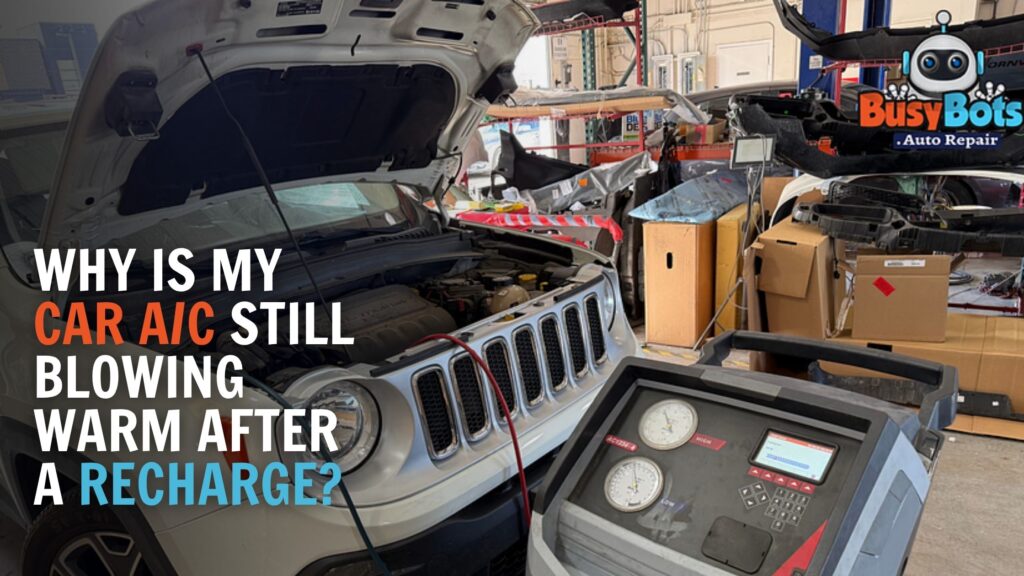
“My A/C Is Warm. It Just Needs Freon.”
Living in Las Vegas, this might be one of the most common assumptions we hear.
The A/C starts blowing warm and the natural reaction is:
“Can you just recharge it?”
Sometimes refrigerant is low.
But the more important question is:
Why?
Automotive A/C is a closed system. If a meaningful amount of refrigerant is missing, there may be a leak or another problem that needs attention.
Warm air can also involve:
- Compressor operation
- Condenser airflow
- Cooling fans
- Refrigerant pressure
- Electrical controls
- Pressure or temperature sensors
- Blower performance
- Other climate-control components
Even pressure readings by themselves don’t always tell the complete story. They have to be interpreted with temperature, airflow, compressor operation and what the system is actually doing.
That’s why our auto A/C repair in Las Vegas starts with the symptom and system diagnosis instead of automatically assuming the vehicle needs refrigerant or a compressor.
A/C blowing warm is the symptom.
Diagnosis tells us why.
“My Car Is Overheating. I Think I Need a Radiator.”
Overheating is another perfect example.
A customer may search:
“Why is my car overheating?”
and see radiator, thermostat or water pump among the most common answers.
All three can absolutely cause cooling-system problems.
But so can:
- Coolant leaks
- Low coolant
- Cooling-fan problems
- Restricted coolant flow
- Pressure loss
- Electrical or sensor faults
- Internal engine problems
- Combustion gases entering the cooling system
Even when the vehicle overheats matters.
Does the temperature rise mostly at stoplights?
Does it cool back down once you’re moving?
Does it happen only with the A/C running?
Is coolant disappearing?
Did the problem start suddenly or gradually?
Those details help determine where testing should begin.
For overheating, coolant loss and temperature concerns, our cooling system repair in Las Vegas covers the complete system rather than assuming one component is responsible.
The Same Thing Applies to Transmission Problems
A vehicle hesitates before shifting.
It shudders.
A warning appears.
Maybe it slips under acceleration.
Search those symptoms online and you may quickly end up reading about transmission replacement or rebuilding.
That’s understandably scary.
But not every shifting complaint means the entire transmission has failed.
Fluid condition, electronic controls, sensors, driveline issues and other mechanical conditions can sometimes create symptoms that need to be diagnosed before anyone talks about major replacement.
Our approach to transmission repair in Las Vegas is the same approach we use throughout the shop:
Understand the symptom first. Diagnose the cause. Then discuss the repair.
What Should You Tell Your Mechanic?
You don’t need to know automotive terminology.
And you definitely don’t need to diagnose the car yourself before making an appointment.
The information that often helps us most is very simple:
When did it start?
What exactly does the vehicle do?
Does it happen every time or only sometimes?
Does it happen cold or after the vehicle warms up?
At idle or while driving?
While accelerating or braking?
Does a warning light appear?
Did anything change after another repair?
Does the problem disappear and then come back?
Those details can be much more valuable than saying:
“I think I need a new sensor.”
Bring us what you noticed.
We’ll take it from there.
So, Should You Use ChatGPT to Research a Car Problem?
Sure.
There is nothing wrong with trying to understand what’s happening with your vehicle.
AI can help explain terminology.
It can explain what a warning light means.
It can give you questions to ask your mechanic.
It can help you understand several possible causes before you walk into a shop.
We actually think a customer who understands their vehicle better can have a better conversation with their technician.
Just keep one distinction in mind:
A possible cause is not the same thing as a confirmed diagnosis.
That applies to ChatGPT.
It applies to Google.
It applies to YouTube.
It applies to forums.
And sometimes it even applies to the first assumption made inside a repair shop.
The vehicle still has to be tested.
Why We Prefer Diagnosis Before Parts Replacement
Our goal isn’t to prove the customer wrong.
And it isn’t to replace the largest number of parts possible.
It’s to answer a much simpler question:
What is actually causing the problem?
That means looking at the complaint, gathering the right information, testing the affected system and following the evidence.
Sometimes the customer’s research turns out to be exactly right.
Great.
Now we’ve confirmed it.
Other times the testing takes us somewhere completely different.
That’s exactly why we diagnose first.
Because replacing the wrong part isn’t just frustrating.
It’s expensive.
Bring Us the Symptom. We’ll Find the Cause.
If your vehicle is overheating, the battery keeps dying, the A/C is blowing warm, the Check Engine Light is on, the transmission isn’t behaving normally, or something simply doesn’t feel right, you do not need to figure out which part to ask for before bringing it in.
Tell us what changed.
Tell us when it happens.
Tell us anything you’ve already learned—including what AI suggested.
Then let the vehicle tell us the rest.
Busy Bots Auto Repair provides full-service mechanical diagnostics, repair and maintenance in Las Vegas for domestic, Asian and European vehicles.
📍 6940 W Patrick Ln, Las Vegas, NV 89113
📞 702-399-7007


No comment yet, add your voice below!