Cooling System Repair in Las Vegas
Professional Radiator, Water Pump, Thermostat & Engine Overheating Diagnosis
Protect Your Engine Before a Small Cooling System Problem Becomes a Major Repair
Las Vegas is one of the harshest environments in the country for your vehicle. Summer temperatures regularly exceed 110°F, heavy traffic keeps engines idling for long periods, and steep highway grades place additional stress on every cooling system component. Under these conditions, even a small cooling system problem can quickly become an expensive engine repair if left unresolved.
If your vehicle is overheating, losing coolant, running hotter than normal, or displaying an engine temperature warning, it’s important to identify the root cause—not simply replace parts based on assumptions.
At Busy Bots Auto Repair, we specialize in complete cooling system diagnosis and repair for domestic, Asian, European, hybrid, and electric vehicles. Our ASE-certified technicians use advanced diagnostic equipment, manufacturer repair information, and years of hands-on experience to accurately diagnose overheating problems before recommending repairs.
Whether your vehicle needs a radiator replacement, water pump repair, thermostat replacement, cooling fan diagnosis, coolant leak repair, or a complete cooling system inspection, our goal remains the same:
Diagnose the problem correctly. Repair it correctly. Help you avoid unnecessary repairs.
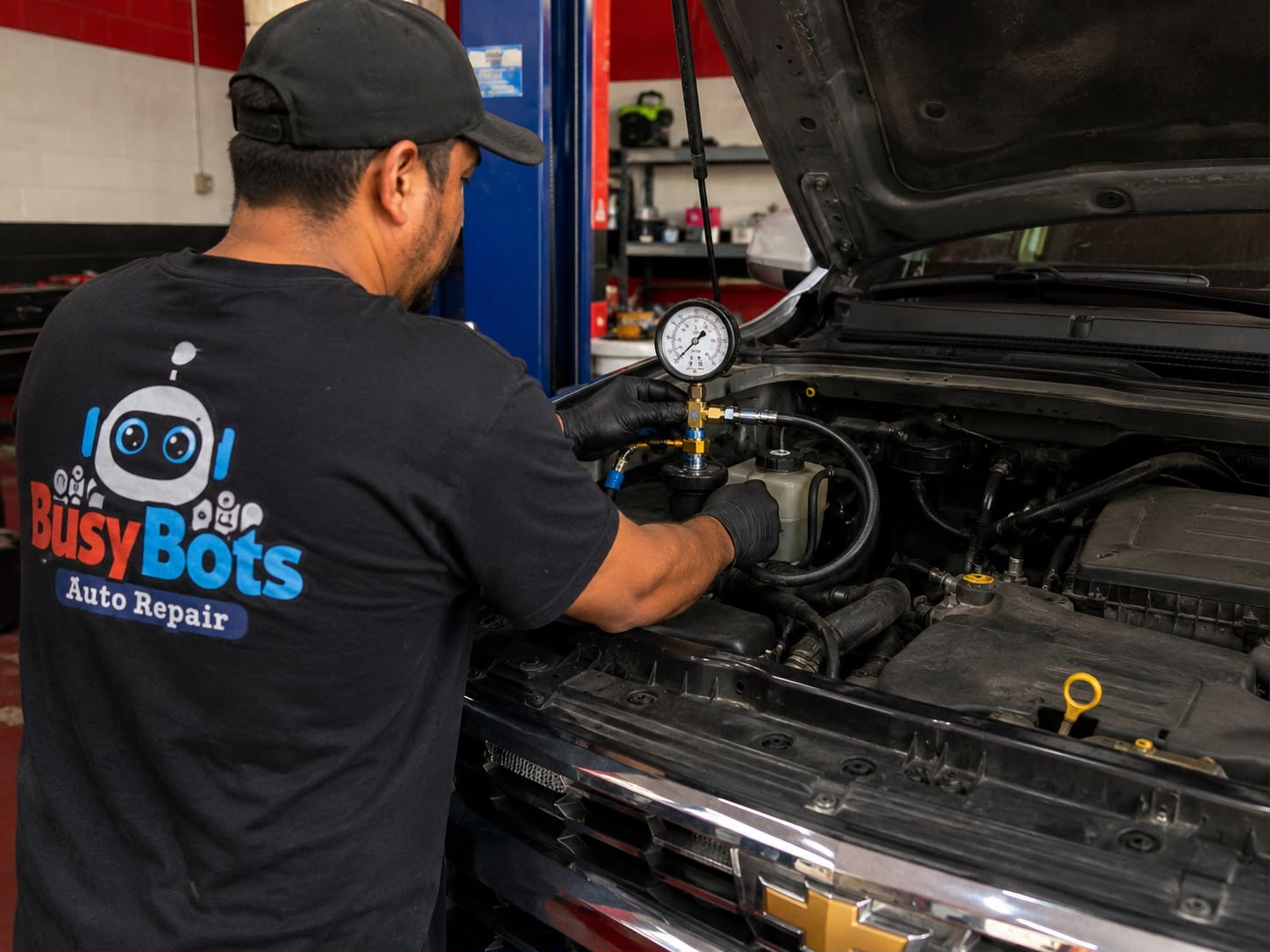
Why Your Cooling System Is One of the Most Important Systems in Your Vehicle
Most drivers never think about the cooling system until the temperature gauge starts climbing or steam appears from under the hood.
In reality, the cooling system protects one of the most valuable components of your vehicle—your engine.
Every second your engine is running, thousands of controlled combustion events generate tremendous heat. Without a properly functioning cooling system, engine temperatures would rise beyond safe operating limits within minutes.
The cooling system continuously circulates coolant through passages inside the engine block and cylinder head, where it absorbs heat before flowing to the radiator. As outside air passes through the radiator, heat is released, allowing the coolant to cool before repeating the cycle.
This process happens continuously while your vehicle is running.
When every component works correctly, your engine maintains its ideal operating temperature, fuel economy remains consistent, emissions stay under control, and internal engine components are protected from excessive heat.
When even one component begins to fail, however, the entire system can become less efficient.
That’s why something as small as a leaking hose or sticking thermostat should never be ignored.
Every overheating problem tells a story
When a customer arrives with an overheating complaint, the first question isn't "Which part should we replace?" The first question is "When does the vehicle overheat?" The answer often provides valuable clues.
🚗
Engine overheats only while sitting in traffic
▾
This usually points toward an airflow problem rather than coolant circulation. Our technicians inspect:
- Electric cooling fan operation
- Cooling fan relays
- Fan control modules
- Engine coolant temperature sensors
- Airflow through the radiator and condenser
🛣️
Engine overheats on the freeway
▾
Highway overheating usually suggests coolant circulation problems. Common causes include:
- Restricted radiator
- Worn water pump
- Thermostat not opening completely
- Low coolant level
- Internal engine restriction
❄️
Engine overheats only when the A/C is running
▾
Running the air conditioner increases the heat load placed on the cooling system. If temperatures rise only while using the A/C, we inspect:
- Cooling fan performance
- Radiator airflow
- Condenser condition
- Cooling capacity
- Coolant circulation
💧
Coolant disappears but there's no visible leak
▾
Coolant doesn't simply evaporate under normal conditions. This symptom may indicate:
- Small external leak
- Heater core leak
- Water pump leak
- Pressure cap failure
- Internal engine leak
Pressure testing often reveals problems that aren't visible during a routine inspection.
🌡️
Heater suddenly blows cold air
▾
Many drivers don't realize their heater is directly connected to the engine cooling system. Loss of cabin heat may indicate:
- Low coolant
- Air trapped in the system
- Thermostat failure
- Restricted heater core
This symptom should never be ignored.
What We See Every Week at Busy Bots Auto Repair
One of the biggest misconceptions about overheating is that replacing the radiator automatically fixes the problem.
In our experience, that’s often not the case.
Every week we inspect vehicles that have already had parts replaced somewhere else without solving the original problem.
We’ve diagnosed overheating caused by faulty cooling fans, sticking thermostats, leaking water pumps, clogged radiators, damaged hoses, trapped air in the cooling system, and even internal engine issues that initially looked like simple coolant leaks.
This is why our technicians never rely on guesswork.
Every repair begins with understanding why the engine is overheating.
That philosophy saves our customers money, prevents unnecessary parts replacement, and results in more accurate repairs.
Why Accurate Diagnosis Matters
Two vehicles can arrive with exactly the same symptom—an overheating engine—but require completely different repairs.
One may have a failing thermostat.
Another may have a clogged radiator.
A third may have a leaking water pump.
A fourth could have a faulty electric cooling fan that only fails when the vehicle is idling.
Without proper testing, replacing parts becomes guesswork.
At Busy Bots Auto Repair, we believe diagnosis is the most important step in any cooling system repair. By identifying the root cause before replacing components, we help ensure the repair is done correctly the first time.
Cooling System Repairs We Perform
Once diagnostics identify the source of the problem, our technicians perform repairs using quality replacement components that meet or exceed manufacturer specifications.
Radiator Repair & Replacement
Radiators remove heat from engine coolant before it returns to the engine.
Leaks, corrosion, internal restrictions, impact damage, or deteriorated plastic tanks can reduce cooling efficiency.
Before replacing a radiator, we inspect the complete cooling system to ensure another component isn’t contributing to the problem.
Related Page → Radiator Repair Las Vegas
Water Pump Replacement
The water pump is responsible for circulating coolant through the engine.
A failing bearing, leaking seal, or damaged impeller can reduce coolant flow and quickly lead to overheating.
Many water pumps are driven by the timing belt or timing chain, making proper installation and inspection critical.
Related Page → Water Pump Replacement Las Vegas
Thermostat Replacement
A faulty thermostat may cause the engine to overheat or prevent it from reaching normal operating temperature.
Because similar symptoms can be caused by other cooling system failures, we test thermostat operation before recommending replacement.
Cooling Fan Diagnosis & Repair
Electric cooling fans are especially important in Las Vegas traffic.
Our technicians diagnose:
- Cooling fan motors
- Fan relays
- Wiring
- Control modules
- Temperature sensors
before replacing components.
Coolant Leak Detection
Some coolant leaks leave obvious puddles.
Others only leak under pressure or while driving.
We use professional pressure testing and visual inspection to identify hidden coolant leaks throughout the entire cooling system.
Coolant Flush & Cooling System Service
Engine coolant gradually loses its ability to protect against corrosion and overheating.
Replacing coolant at the manufacturer’s recommended interval helps protect:
- Radiator
- Water pump
- Heater core
- Engine block
- Cylinder head
- Hoses
- Seals
Routine coolant service is one of the simplest ways to extend cooling system life.
What Makes Busy Bots Different?
Most repair shops replace parts.
Our technicians diagnose systems.
That difference matters.
A professional diagnosis helps eliminate guesswork, reduces unnecessary repairs, and ensures your vehicle receives the repair it actually needs—not simply the repair that seems most likely.
Whether your vehicle needs a radiator, thermostat, water pump, cooling fan, coolant flush, or complete cooling system repair, our focus is always the same:
Identify the problem. Explain the findings clearly. Repair it correctly the first time
Why Las Vegas Drivers Trust Busy Bots Auto Repair
Cooling system problems aren’t always obvious, and replacing parts based on assumptions can quickly become expensive. That’s why every repair at Busy Bots Auto Repair begins with one priority—accurately identifying the root cause before recommending any repairs.
Our ASE-certified technicians combine advanced diagnostic equipment, manufacturer repair procedures, and years of hands-on experience to diagnose cooling system problems on domestic, Asian, European, hybrid, and electric vehicles. Whether the issue is a leaking radiator, failing water pump, sticking thermostat, faulty cooling fan, coolant leak, or intermittent overheating, our goal is to repair the problem correctly the first time.
We believe every customer deserves honest recommendations, clear communication, and repairs based on testing—not guesswork. From routine cooling system maintenance to complex engine overheating diagnosis, we’re committed to helping Las Vegas drivers keep their vehicles reliable, safe, and ready for the road ahead.
Don’t Ignore the Warning Signs
Cooling system problems rarely fix themselves.
A small coolant leak today can become an overheated engine tomorrow. A worn thermostat or failing cooling fan may seem like a minor inconvenience until it leaves you stranded on a hot Las Vegas afternoon. In many cases, early diagnosis is the difference between a routine repair and a major engine replacement.
If you’ve noticed your temperature gauge climbing, coolant leaking, your heater blowing cold air, or your engine running hotter than normal, don’t wait until the problem gets worse.
The sooner a cooling system problem is diagnosed, the easier—and often less expensive—it is to repair.
Schedule Your Cooling System Inspection
Whether you’re dealing with an overheating engine, coolant leak, radiator problem, water pump failure, thermostat issue, or simply want peace of mind before your next road trip, Busy Bots Auto Repair is here to help.
Our ASE-certified technicians provide complete cooling system diagnostics and repairs using professional equipment, quality parts, and manufacturer-recommended repair procedures.
We’re proud to help drivers throughout Las Vegas protect one of the most important parts of their vehicle—the engine.
Schedule your cooling system inspection today and let our team identify the problem before it becomes a major repair.
About Busy Bots Auto Repair
Busy Bots Auto Repair has proudly served Las Vegas drivers from the same location since 1984. While ownership has evolved over the years, one thing has remained the same—a commitment to honest, dependable automotive repair. Today, our ASE-certified technicians combine decades of experience with advanced diagnostic technology to deliver trusted repairs for domestic, import, European, hybrid, and electric vehicles. From routine maintenance to complex engine diagnostics, we are committed to quality workmanship, transparent recommendations, and customer service that keeps our community safely on the road.
What Las Vegas Drivers Say About Busy Bots Auto Repair
Real feedback from customers who trust us for honest, fast, and reliable auto repair services in Las Vegas.
Trustindex verifies that the original source of the review is Google. I had a great experience with this mechanic and highly recommend their services. From the start, they were honest, transparent, and took the time to clearly explain what was going on with my vehicle. There was no pressure to approve unnecessary repairs, just straightforward advice and fair pricing. The work was completed efficiently, and everything was done right the first time. It’s not easy to find a mechanic you can truly trust, but this is definitely one of them. Their professionalism, integrity, and attention to detail really stand out. If you’re looking for reliable and honest service, this is the place to go.Posted on GoogleTrustindex verifies that the original source of the review is Google. Really great experience here. From the start, everything felt straightforward and honest. Mike took the time to explain what was going on in a way that actually made sense, and I never felt pressured into anything. The pricing was fair, the service was quick, and the whole process was way easier than I expected. You can tell they actually care about their customers. I’d definitely come back and I definitely recommend them to anyone looking for a reliable shop.Posted on GoogleTrustindex verifies that the original source of the review is Google. I had the radiator replaced on my 2013 Infiniti G37. Mike was great! I was able to get a quote over the phone for labor cost only—I brought a new radiator for this replacement. It’s a reasonable price for the efficient and great service. They also keep you up to date on the status of the repair.Posted on GoogleTrustindex verifies that the original source of the review is Google. Went here a couple times now for an oil change they have my special oil (hybrid) Great service, great customer care! Fast and great price! Thank you!Posted on GoogleTrustindex verifies that the original source of the review is Google. I called around several mechanics in the area, & compared to all the corporate chains, these guys were by FAR the most competitively priced. They’re also really nice guys. I had a rough idea of some of the work that needed taking care of on my car (Mercedes GLC 300), but regardless, they were transparent about all the labor/parts/costs etc. which is a big relief, & it’s the way everyone wants to feel when it comes to such an expense. Thanks again guys!Posted on GoogleTrustindex verifies that the original source of the review is Google. Many thanks to Mike for the excellent work and great customer service!Posted on GoogleTrustindex verifies that the original source of the review is Google. Always great customer service. It’s my go to place for car maintenance.Posted on GoogleTrustindex verifies that the original source of the review is Google. Would highly recommend this auto shop! Maximus was very professional great customer service & had great prices will definitely recommend.Posted on GoogleTrustindex verifies that the original source of the review is Google. Max Yanez service-my vehicle and did an outstanding job. I would recommend Busy bots’
Professional Cooling System Diagnosis: Why Guessing Can Be Expensive
One of the most common mistakes we see is replacing parts before identifying the actual cause of the problem.
An overheating engine does not automatically mean you need a new radiator.
In fact, multiple cooling system components can produce nearly identical symptoms.
A thermostat that sticks closed, a weak water pump, a failing cooling fan, low coolant level, restricted radiator, collapsed radiator hose, trapped air in the system, or even an internal engine problem can all cause the engine temperature to rise.
Replacing parts without testing may temporarily improve symptoms—or fail to solve the problem altogether.
That’s why professional diagnosis is often the most valuable part of the repair.
At Busy Bots Auto Repair, we don’t believe in guessing. Every cooling system inspection begins with understanding the symptoms, testing the system, and identifying the true cause before recommending repairs.
Frequently Asked Questions
If your vehicle overheats only at stoplights or in slow-moving traffic, the cooling system may not be getting enough airflow through the radiator. The most common causes are a failing electric cooling fan, fan relay, temperature sensor, or fan control module. At Busy Bots Auto Repair, we test the entire cooling fan system to identify the exact cause before recommending. If your vehicle runs normally while driving but the temperature rises when you stop, learn more about why a car may overheat in traffic but not while driving.
Highway overheating often points to a coolant circulation problem rather than an airflow issue. A restricted radiator, failing water pump, stuck thermostat, or low coolant level can prevent the engine from staying cool under higher loads.
No. Driving an overheating vehicle can cause severe engine damage in just a few minutes. If your temperature gauge enters the red zone or you see steam coming from under the hood, pull over safely, shut the engine off, and have the vehicle inspected before driving again.
Coolant should never simply "run low." If you're adding coolant regularly, there's usually a leak somewhere in the system or, in some cases, an internal engine problem. A pressure test is the most effective way to locate the source of the leak.
Signs of a failing radiator include coolant leaks, engine overheating, rust or corrosion, damaged cooling fins, and restricted coolant flow. However, overheating isn't always caused by the radiator. Professional diagnostics help determine the actual problem before replacing parts.
Common symptoms include coolant leaking near the front of the engine, whining or grinding noises, engine overheating, steam from the engine compartment, or visible wobble in the water pump pulley. A worn water pump can quickly lead to overheating if not repaired.
A faulty thermostat may cause the engine to overheat, run colder than normal, produce poor cabin heat, or show fluctuating temperature readings. Because these symptoms can overlap with other cooling system issues, proper testing is important before replacement
Your heater relies on hot engine coolant. Low coolant, trapped air, a stuck thermostat, or a restricted heater core can all prevent warm coolant from reaching the heater, causing cold air from the vents.
Most manufacturers recommend replacing coolant every 30,000 to 100,000 miles, depending on the vehicle and coolant type. Fresh coolant helps prevent corrosion, lubricates the water pump, and protects the entire cooling system.
Yes. Extreme summer temperatures place additional stress on radiators, cooling fans, water pumps, hoses, and coolant. Regular cooling system inspections are especially important for vehicles driven in Southern Nevada.
A fluctuating temperature gauge may indicate low coolant, air trapped in the system, thermostat problems, or inconsistent coolant circulation. It's a sign that the cooling system should be inspected before the problem worsens.
Yes. On many modern vehicles, cooling system faults can trigger the Check Engine Light or engine temperature warning. Low coolant can also affect engine performance and emissions if the engine begins running hotter than intended.
The engine cooling system and air conditioning system work closely together. If the engine overheats, the vehicle may reduce A/C performance to help lower engine temperatures. A failing cooling fan can also affect both systems at the same time.
Only as an emergency measure to get to a safe location. Water alone doesn't provide the corrosion protection, lubrication, or boiling point required to protect modern engines. The system should be refilled with the manufacturer-recommended coolant as soon as possible.
Yes. Even a small coolant leak can eventually lower coolant levels enough to cause overheating, which may result in expensive engine damage if left unrepaired.
Yes. The radiator cap maintains proper pressure within the cooling system. If it can no longer hold pressure, coolant may boil at a lower temperature, increasing the risk of overheating.
Coolant leaks commonly come from radiators, hoses, water pumps, thermostats, heater cores, reservoirs, hose connections, or worn gaskets. Pressure testing helps locate leaks that may not be visible during a routine inspection.
Adding coolant may temporarily prevent overheating, but it doesn't solve the underlying problem. The leak will continue to worsen over time and could eventually lead to engine damage or roadside breakdown.
Many newer vehicles keep the cooling fan running briefly after shutdown to reduce engine temperatures. If the fan runs excessively or never shuts off, it could indicate a sensor, relay, or control module issue.
Cooling system problems often have multiple possible causes. Our ASE-certified technicians perform complete diagnostics to identify the root cause before recommending repairs. Instead of replacing parts based on guesswork, we use professional testing and manufacturer repair information to repair your vehicle correctly the first time.
SHOP-HOURS
Mon - Fri :-
8:00 am - 6:00 pm
Saturday :-
8:00 am - 2:00 pm
Sunday :-
Closed
ADDRESS :
6940 W Patrick Ln, Las Vegas, NV 89113, United States